lab members
Click for Lab NewsClick for Lab Alumni
 Klaus Hahn, Ph.D.
Thurman Distinguished Professor of Pharmacology
khahn[at]med.unc.edu
NIH Biosketch - 03-2025

Greg Alspaugh
MD/PhD Graduate Student
gregory_alspaugh[at]med.unc.edu

Mingyu Choi
Graduate student
mingyuc[at]live.unc.edu
My PhD project focuses on investigating how mechanosensing behaviors of podosomes regulate adhesion signaling during phagocytosis. To directly control podosome dynamics, I am developing adhesion molecule analogs that can be controlled with light. Additionally, I am developing novel biosensors for key signaling molecules involved in phagocytic signaling. Combining these tools will allow me to probe how cells convert mechanical information to cellular signaling during phagocytosis, and potentially to decipher the role of signaling oscillations in sensing and responding to the mechanical properties of the substrate.


Saygin Gulec
Graduate Student
sayging[at]live.unc.edu
I study GTPases and how the feedback loops they participate in result in spatiotemporal patterns that lead to the emergence of complex cellular behaviors. One of these behaviors is the formation of podosomes during phagocytosis. I use novel biosensors developed in our lab to track the activity of individual GTPase molecules and use this data to build mathematical models that helps us analyze and understand the regulatory reaction network that gives rise to such behaviors.

Lihua He, Ph.D.
Research Assistant Professor
lhe[at]email.unc.edu
The “binder/tag” approach, which utilizes the interaction of a 7 amino acid peptide SsrA (tag) and a small protein SspB (binder) to reveal protein conformation, has been employed to probe the conformational changes of individual Src family proteins in living cells. My research extends this approach to identify orthogonal binder/tag pairs for multiplexed biosensor imaging, and applies the binder/tag approach to report the activities of Rho family GTPase guanine exchange factors (GEFs).
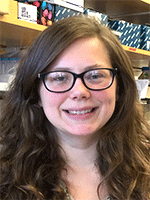
Megan Kern
Graduate Student
megkern[at]live.unc.edu
My project, working between the Hahn and Superfine labs, uses combined Atomic Force Microscopy (AFM) and line-Bessel light sheet imaging to study engulfment forces during phagocytosis. This system allows for fast, high resolution imaging in the plane of force as well as volumetric imaging synchronous with sensitive AFM force measurements. With this system we have correlated the accumulation of actin around antibody-coated phagocytic targets to downward, cell-driven engulfment forces. In 3D, we have also observed podosomes in the early stages of phagocytic cup formation. Currently, we are working on a model based on parametrized geometrical quantities of the target contact area to fit the observed engulfment forces during phagocytosis. Furthermore, we have attached deformable and fluorescently labeled polyacrylamide beads to the AFM cantilever, now allowing us to investigate the local, podosome-driven deformations on the target as well as the overall downward engulfment forces.
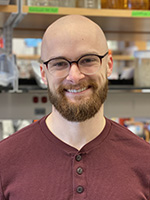 Gabe Kreider-Letterman, Ph.D.
Postdoctoral Fellow
Gabriel_Kreider-Letterman[at]med.unc.edu
Key to cancer cell metastasis is the ability of cancer cells to invade through their extracellular environments. The changes that occur during this process involve coordination between multiple signaling pathways that are linked to cell adhesion and matrix remodeling. The relationship between the intracellular signaling and the extracellular environment is bidirectional - intracellular signals influence how cells respond to their environment, and differences in the extracellular environment modulate intracellular signaling that determines cell behavior. My research focuses on understanding how cancer cells sense their extracellular environment through mechanosensitive proteins, and how mechanical forces are translated into intracellular signals. To achieve this, I am pursuing the following directions:
1. I am using the recently developed Binder/Tag approach to generate biosensors for the key mechanosensitive protein Talin, which integrates force sensing with many signaling pathways. This tool allows for precise visualization of Talin conformational changes, induced by acto-myosin forces, and the resulting changes in Talin scaffolding function. Understanding when and where tension induces scaffolding changes in Talin will reveal how Talin coordinates responses to heterogeneous forces and ECM interactions.
2. Using our new capacity for biosensor multiplexing, I am exploring how cellular signals from the Rho family of GTPases are regulated within and around cellular adhesions. I am particularly focusing on invadopodia, degradative adhesion structures that facilitate cancer cell invasion by remodeling the ECM. Although it is known that Rho GTPase activity is regulated by invadopodia, the mechanism and role of GTPase coordination at these structures is not yet well understood. Gaining insights into Rho GTPase signaling at invadopodia will not only deepen our understanding of invadopodia-based invasion, but also have broader implications for the localized regulation of Rho GTPases by specific structures.
 Liz McInnis
Graduate Student
ealderma[at]email.unc.edu
I am a graduate student working with Klaus Hahn and Ron Falk to investigate the dynamic pathways involved in patients with Minimal Change Disease (MCD). MCD is a rare inflammatory disease that causes kidney damage primarily in young children, due to the loss of podocyte foot processes. Podocyte foot processes form a junction called the slit diaphragm, which acts as a filter keeping large proteins from leaking into the urine. A central question in the field is what drives the morphological changes of podocytes in patients with MCD. I am exploring this with traditional approaches and by developing a biosensor to study how the protein nephrin interacts with neighboring cells to form the slit diaphragms.
 Vairaprakash Pothiappan, Ph.D.
Postdoctoral Fellow
pothi[at]email.unc.edu
Trained in Synthetic Organic Chemistry, and development of various photo-functional molecules, my current interest in Hahn lab is in developing biosensors. I am focused on tailoring funcional fluorophores for single-molecule tracking of conformational changes in live cells, and techniques to report conformation in super resolution microscopy.
 Joseph Szulczewski, Ph.D.
 Postdoctoral Fellow
jszulczewski[at]unc.edu
I investigate how migrating cells “feel” mechanical cues—particularly stiffness gradients—to orchestrate pivotal processes like fibrosis and cancer metastasis. While it’s well established that cancer cells reorient and migrate toward stiffer matrices, the molecular machinery that converts mechanical tension into directional movement remains a mystery. My aim is to decode this force-to-signal conversion by engineering state-of-the-art biosensors and assays that reveal, in real time, how cells translate physical force into biochemical commands.
Optogenetic Control of cells “Molecular Clutch”
I have fused a light-sensitive module to vinculin—the cell’s “molecular clutch” that links the actin cytoskeleton to focal adhesions—enabling precise, reversible tuning of vinculin–actin binding with pulses of light. This optogenetic toolkit lets me manipulate focal-adhesion tension on demand, then watch how local force fluctuations guide protrusion dynamics and steer cell migration in living cells.
Conformational Biosensors for Force-Sensing Proteins
Stretching both vinculin and p130Cas reveals dramatic conformational shifts under tension. By harnessing the SPECTr (Small Peptide Exposure for Conformation and Tracking) platform, I’m creating fluorescent biosensors that quantitatively report these shape changes at individual adhesion sites. Pairing real-time biosensor readouts with localized RhoGTPase activity maps, I’m building a high-throughput discovery pipeline to unearth new, force-sensitive signaling proteins.
Micropillar Assay for Cell-Scale Durotaxis
Standard durotaxis assays span entire substrates and miss the fine-scale stiffness variations cells experience in tissues. To address this, I developed the Topology-Independent Micropillar (TIM) assay, which generates steep, cell-sized stiffness gradients across micropillar arrays. This innovation affords unprecedented spatial resolution—allowing us to pinpoint how anisotropic traction stresses influence cell polarity, protrusive behavior, and RhoGTPase activation.
By weaving together optogenetics, conformational biosensors, and precision microengineering, I aim to illuminate the hidden language of force-dependent signaling that underlies cell migration in both health and disease.



Pengning Xu, Ph.D.
Postdoctoral Fellow
pengning[at]unc.edu
I am interested in developing novel biosensors as well as improving optical instrumentation and quantitative analysis for single particle tracking (SPT), which reveals activity and diffusivity of individual biomolecules. Currently, I focus on using SPT to reveal the mechanism of the Cdc42 GTPase signaling in cell migration organelles such as podosomes, invadopodia, and focal adhesions.
 Yu Yan, Ph.D.
Postdoctoral Fellow
yu_yan[at]med.unc.edu
I am interested in designing and synthesizing environment-sensing fluorescent dyes that report changes in their surrounding micro-environment, including protein conformational changes. Currently, my project is focused on merocyanine derivatives conjugated with affinity groups for biosensors used in single particle tracking (SPT).


Future Postdoctoral Fellow, Graduate Student or Tech
 Hahn lab at Spring Haven Goat Farm 2024